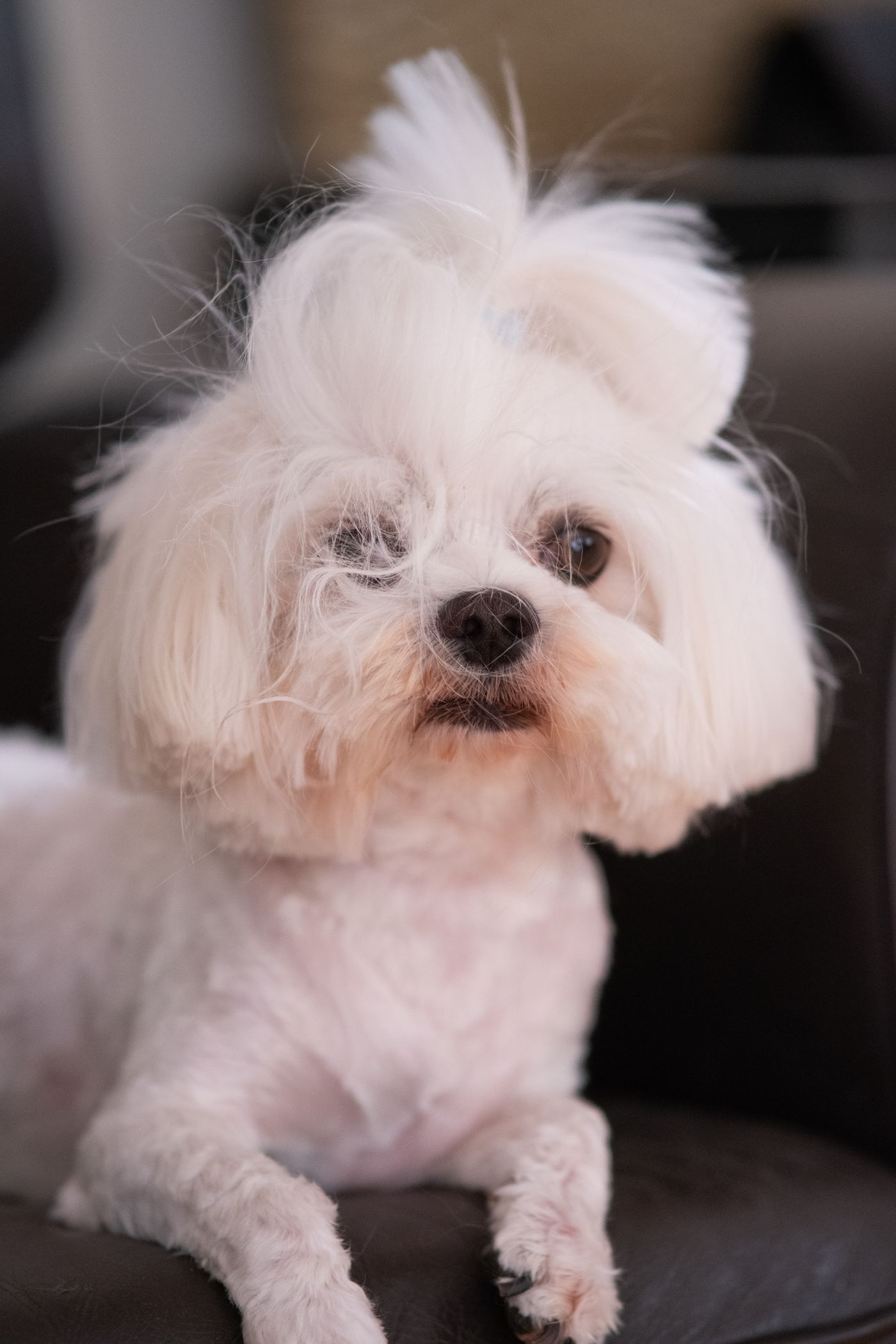
Short answer: if you want the most predictable coat, shedding, and size, since it's a purebred with a fixed AKC standard, lean Maltese. If you like the Maltese look and temperament but want a size option beyond "always under 7 pounds," or don't mind a bit of litter-to-litter variation in exchange for a curlier, Poodle-influenced coat, the Maltipoo is a genuinely good, honest choice too. Longer answer: these two get compared constantly because the Maltipoo is literally half Maltese, but the real differences show up in coat consistency, size range, and health testing norms, not in some vague "better breed" verdict. Here is the honest side by side.
Our take
The short version
The Maltese has the edge on predictability. Its single-layer coat and under-7-pound size are locked in by a breed standard that hasn't changed in generations, so what you see in one Maltese litter is close to what you'll get in the next. The Maltipoo has the edge on range: a Toy Maltipoo sits close to Maltese size, while a Mini Maltipoo can run up to 20 pounds, an option no Maltese line offers, and its coat can lean anywhere from wavy to tightly curled depending on how much Poodle is in that litter. For the steadiest, lowest-shed coat, breeders point to F1B or higher-Poodle-percentage Maltipoo litters, which land close to the Maltese's own shedding level. Both breeds average a similar 10-to-15-year lifespan, both are prone to patellar luxation and dental disease, and neither is allergy-free. If predictability is your top filter, lean Maltese. If size flexibility and the Maltese-Poodle blend appeal to you, the Maltipoo is not a fallback, it's a real contender.
Coat, allergens, size, and temperament, together
Thirteen points that actually matter when you're choosing between the two, on the axes that drive allergy fit: coat type, allergen mechanism, shedding, size, and temperament fit.
Swipe sideways on a phone to see the Maltipoo column.
| What matters | Maltese | Maltipoo |
|---|
| Parentage | Purebred, AKC-recognized toy breed | Maltese x Toy or Miniature Poodle, not AKC-recognized (registered by mixed-breed clubs like the American Canine Hybrid Club) |
| Coat type | Single-layer, silky, straight, no undercoat | Varies by generation: wavier at F1, curlier and more Poodle-like at F1B and beyond |
| Allergen mechanism | Dander and hair-borne proteins, with no seasonal undercoat blowout to scatter them | Same dander mechanism, but a curlier F1B coat traps more loose hair and dander than a straighter F1 coat |
| Shedding | Consistently low, breed standard is fixed | Low at F1B and higher-Poodle litters, closer to moderate at F1 |
| Most predictable pick for allergies | Any purebred Maltese, coat is genetically consistent litter to litter | An F1B or higher-Poodle-percentage litter, ask the breeder directly |
| Standard size | Under 7 lbs, about 7 to 9 in tall | Toy: roughly 5 to 10 lbs, 8 to 10 in. Mini: roughly 10 to 20 lbs, 11 to 14 in |
| Size predictability | High, fixed breed standard | Lower, depends on the Poodle parent and generation |
| Temperament | Affectionate, playful, alert, gentle | Easygoing, affectionate, socially attached, can be shy without early socialization |
| Exercise needs | Low to moderate, short walks and play | Low to moderate, similar to Maltese |
| Grooming | Daily brushing to keep the long coat tangle-free, or a shorter "puppy cut" | Regular brushing several times a week, curlier F1B coats mat faster and need trims every 6 to 8 weeks |
| Known health considerations | Patellar luxation, dental disease, white dog shaker syndrome | Patellar luxation, progressive retinal atrophy, dental disease |
| Average lifespan | Roughly 12 to 15 years | Roughly 10 to 15 years |
| Typical price | Roughly $1,000 to $3,000 from a health-testing breeder | Roughly $1,500 to $4,000 from a health-testing breeder, more for rare coat colors |
Pick a Maltese if
- You want the most predictable coat and shedding profile available, backed by a fixed breed standard.
- You're comfortable with daily brushing to keep a full-length silky coat tangle-free.
- You want a dog that reliably stays under 7 pounds.
- You'd rather work from generations of established breed history than litter-to-litter variation.
Pick a Maltipoo if
- You like the Maltese look and temperament but want a size option beyond "always tiny," like a 10-to-20-pound Mini.
- You're comfortable choosing an F1B litter specifically for the most consistent low-shed coat.
- You don't mind extra grooming, since curlier F1B coats mat faster than a straight Maltese coat.
- You're equally committed to asking about parent health testing, since hybrid vigor doesn't remove the patellar luxation risk either breed carries.
The honest part
Neither breed is allergy-free, and a Maltipoo's generation matters as much as its name
It would be easy to declare a flat winner here. We won't, because "Maltipoo" alone doesn't tell you how much Poodle is actually in that dog, and a purebred Maltese's consistency is a real strength, not a knock against the mix.
- Shedding and dander aren't the same thing. A dog can shed very little hair while still carrying dander that bothers a sensitive person, or the reverse. Coat generation (F1 versus F1B) tracks a Maltipoo's allergen exposure more reliably than the name "Maltipoo" alone does.
- Hybrid vigor is not a health guarantee. A large study of dogs found that crossbred "hybrid vigor" did not reduce the rate of patellar luxation, meaning a Maltipoo carries roughly the same knee risk as its Maltese parent, not less.
- A well-bred F1B Maltipoo can outshed a poorly-bred Maltese, and the reverse. Coat generation and breeder health testing matter more than the breed label on the listing. Ask directly what generation a Maltipoo litter is, and ask any breeder of either breed for their patella, eye, and dental testing records.
Maltese vs Maltipoo, quick answers
Is a Maltese or a Maltipoo better for allergies?
Neither is allergy-free. The Maltese has a single-layer silky coat with no undercoat, so its shedding and dander release stay fairly predictable litter to litter, since it's a purebred with a fixed breed standard. The Maltipoo's coat depends on how much Poodle influence it inherited: an F1B Maltipoo (bred back to a Poodle, roughly 75% Poodle) tends to have the curliest, most consistently low-shedding coat, while an F1 Maltipoo's coat runs closer to a 50/50 blend and can shed a bit more. If allergies are a serious concern, meet the specific adult dog before committing, regardless of which breed you lean toward.
What's the difference between an F1 and F1B Maltipoo coat?
An F1 Maltipoo is a straight cross of a purebred Maltese and a purebred Poodle, roughly 50/50. An F1B Maltipoo is an F1 Maltipoo bred back to a purebred Poodle, which pushes the coat closer to 75% Poodle. That extra Poodle influence usually means a curlier, denser coat that sheds less and mats faster, which is why breeders commonly recommend F1B litters to allergy-sensitive buyers.
Which sheds more, a Maltese or a Maltipoo?
A purebred Maltese sheds lightly and consistently, since its single-layer coat never blows an undercoat the way a double-coated breed does. A Maltipoo's shedding depends on generation: an F1B Maltipoo, at highest Poodle influence, typically sheds about as little as a Maltese. An F1 Maltipoo, with less Poodle influence, tends to shed a little more than either. Individual dogs vary either way.
Are Maltipoos or Maltese bigger?
Maltese are consistently small: the AKC breed standard caps them under 7 pounds, standing 7 to 9 inches tall. Maltipoos vary more, since size depends on whether the Poodle parent was a Toy or a Miniature. A Toy Maltipoo runs roughly 5 to 10 pounds and 8 to 10 inches tall, closest to a Maltese. A Mini Maltipoo runs larger, roughly 10 to 20 pounds and 11 to 14 inches, an option no Maltese line offers.
Which has the calmer temperament, a Maltese or a Maltipoo?
Maltese are commonly described as affectionate, playful, and alert, with a temperament that's fairly predictable litter to litter since it's a purebred standard. Maltipoos are usually described as easygoing, affectionate, and social, strongly attached to their people, though breeder guides note they can be shy without enough early socialization. Both suit calm households; the Maltipoo's temperament simply carries a bit more litter-to-litter variation, the same way its coat does.
How long do Maltese and Maltipoos live?
Maltese typically live 12 to 15 years. Maltipoos average 10 to 15 years. Both breeds are prone to patellar luxation (a slipping kneecap common in small dogs) and dental disease, and Maltipoos are also watched for progressive retinal atrophy, an inherited eye condition. Health testing on the parents, not breed alone, is the biggest lever on how long either dog lives well.